July 25, 2025
Prasad: A Gift from God to Man
This year while planning the 100th Silence Day celebration at the Center, the programming group came up with an idea to serve rava with chai on July 10th. The thought found its roots in the nostalgia of being at Baba’s samadhi for various events such as the early morning celebrations of His birthday at the Tin Shed and on other occasions where one could witness the child-like delight with which the Eastern mandali shared this much-loved treat.
The word prasad comes from the Sanskrit word “prasada” which means “gracious gift,” “blessing,” “divine grace,” or “offering.” In Vedic Literature, prasad is also associated with the word “prassana,” which means “to please.”
It is common practice across the world religions to offer food to God before it is eaten by a congregation or a family. This food in turn is infused with His love and blessings. In Eastern temples and places of worship, prasad has two things in common: it is always sweet and despite its variations, it is traditionally a rendering of what we know today as a type of halwa. The word halwa comes from the Arabic word “hulw” which simply means “sweet.” In India, a similar preparation is called “sheera” which has roots in the original halwa introduced to the Indian sub-continent by the Mughals and completely embraced by Hinduism over the years.
Indian sheera began to be associated with “rava” or semolina which became the primary grain used in the preparation. According to Indian mythology, the dish was first made for Lord Krishna who was known to have a sweet tooth. Meher Baba also told us that Krishna was the first Avatar to institute the custom of prasad.
Having been tasked with the job to help create this special dish, I spoke to Keren Rice, a friend and co-worker. As usual, she had some good questions: “Do we have a credible recipe for two hundred people? Is it wise to make a hot dish and serve it on a hot day out in the open? Does it have to be rava?” No, I did not have a recipe. I was not sure if it was wise given the heat. And the only reason that popped up for me, for it to be rava, was simply because it was and is prasad food. That was enough to rouse and convince Keren’s generous and reverent spirit. She took charge and decided to find a recipe and make rava for the two hundred people expected that day. But that was not it, Baba had another player in mind. And her turn was yet to come.
When I went home from talking to Keren, I remembered that the best rava I ever had was made here at the Center by Parinaz Bastani, an Iranian-Canadian Baba lover, who often visits the Center with her family. Just at the time I wondered if I should ask Keren to reach out to her for a recipe, Keren had the exact same thought and acted on it immediately by emailing Parinaz. Parinaz says, “When I received that email, I was stumped. I do not cook with recipes. My style is more intuitive. How then was I supposed to give a recipe? And yet, it was so monumental for the Center to ask this of me. I knew right away that I had to go help make it.”
But things were not so straightforward for Parinaz. Her dear husband, Feraydun, had been going through intense health challenges that had taken a toll on the entire family. She had felt so hopeless and helpless with her husband’s health. People around her suggested that she needed a vacation but that was the last thing she could think about! When this offer came, she knew that it was not a vacation but a pilgrimage that she had needed.
Despite his own hardship, her husband supported her going and their daughter, Mehera, stepped in to help. Her brother and sister-in-law from Washington DC drove down her special ingredients to the Center on their way to Florida. Now, Parinaz was assured that even if her husband’s health took a turn for the worse, Keren would have the right ingredients to work with. Baba orchestrated everything so that she could leave for just three days. Her travel was smooth and she arrived at the Center on July 9th and got to work right away along with Keren.
Rava in India is often plain. It contains ghee or butter, semolina and sugar and maybe some nuts. But Parinaz’s rava is a beast of a different caliber. It is fragrant, colorful, rich and irresistible: fit to serve a king. So, what is her special recipe? I ask.
“It is something I developed over the years,” she says. Her ingredients include saffron, rose water, nutmeg, whole milk, cardamon, pistachios, almonds, raisins and more. “For Zoroastrians, it reminds them of a famous ice cream in Iran called Akbar Mashti, which is often had as an ice cream sandwich,” she exclaims with a sparkle in her eye.
Talking about Iran, she goes on to share with me that her great-grandfather was with Baba in India.
Keren Rice and Parinaz Bastani making rava
He belonged to the same village as Sheriarji, Baba’s father. He was sent back to Iran and married her great grandmother. The family also had a connection to Baidul’s family in Iran. When Parinaz was 18 years old, she met another Baba lover from Iran whose passion for Baba moved her so much that she went to Amartithi in the mid 1990s. And since then, there has been no turning away from Baba.
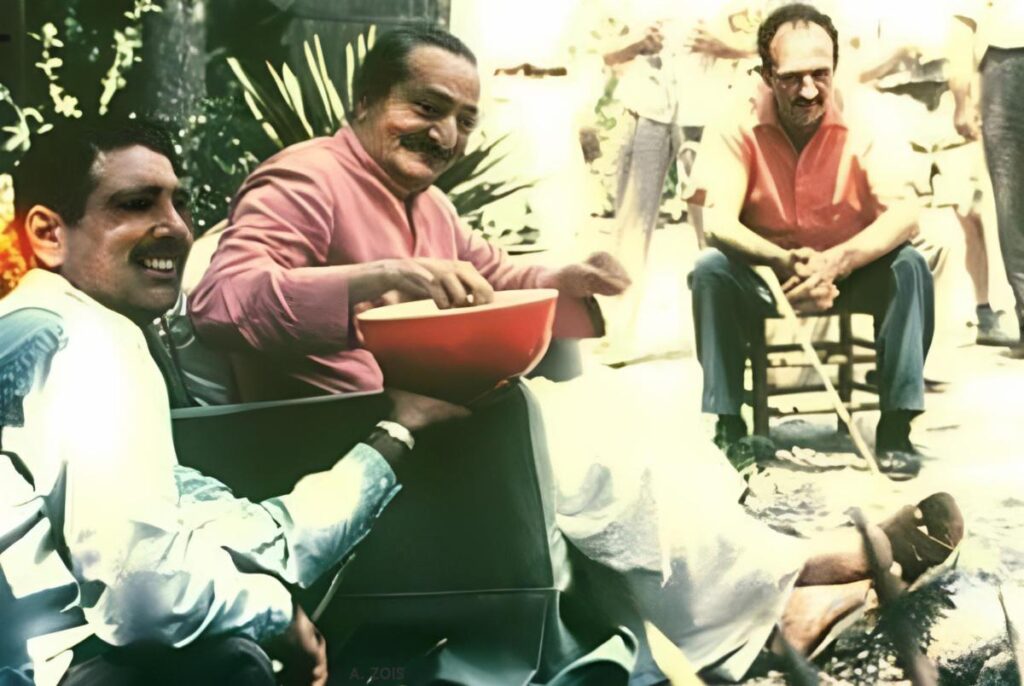
Incidentally it was here at the Center, in May of 1958, that Baba explained the meaning of prasad. One afternoon, the men were invited to Baba’s House and then all assembled in the garden where Baba was seated. Charles Purdom, later wrote, “The atmosphere gradually became more and more surcharged with the sweetness of His love.” He continued: “Baba told the men to fan out so that they might catch the candy He would throw to each. Eruch held a bowl, and Baba told him to stand to His side. Baba began tossing in His usual way, i.e., looking in one direction and throwing in another! When the candy was not caught, it was returned to Eruch, as Baba said it was not to be retained as prasad.
“Baba explained: ‘This is not a game.’ It was a link between Himself and each lover, for the future.’ After everyone had caught his prasad, and some had a rough time doing it, the group gathered in front of Baba and He began to explain the significance of prasad: ‘It is the gift of God to man. If you eat with the feeling that it is that, you benefit; but if you eat it as mere candy, it has no meaning. Don’t give the candy to someone else.’ It was to be eaten immediately by the recipient.”*
*Love Alone Prevails, by Kitty Davy, p. 531
