August 29, 2025
Kitty Davy’s Way with People Part One
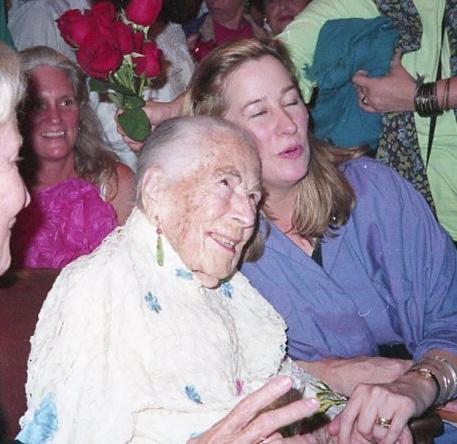
It’s hard to imagine that this week marks Kitty Davy’s 134th birthday and almost 34 years since she “gently slipped into her darling Baba’s arms.”1 That’s in part because her spirit – her unwavering devotion to Baba, unflagging enthusiasm, and example as an always cheerful servant, still imbue the Center through the lives she touched. She was, for many, a living example of Baba’s love in action.
“Her gift was that she was so totally plugged into Baba and [she was] unselfconscious, there was nothing ever about herself,” says Buz Connor. “And she would often say things to people about their lives that she couldn’t possibly have known, and sometimes it was things that they didn’t even know, but that later came to fruition. So she, in that way, was kind of like a channel for Baba, but in a completely unconscious way.”
Kitty first met Baba in 1931 when He stayed at her family’s home at 32 Russell Road in Kensington on His first trip to the West. At the time, He asked Kitty if there was anything she wanted. And she famously replied, “Yes, Baba, only two things I have always desired: an increased capacity to love and increased opportunities for service…. And yes, spontaneous goodness.”2 Baba told her she would “have all in a few days.”3
From then on, Kitty devoted herself to Baba, living with Him in India from 1937 until 1952, when He asked her to stay in Myrtle Beach to help Elizabeth Patterson and Norina Matchabelli with the Center. She thought at the time it was temporary and that Baba would call her back to India. But she stayed until her death in 1991, serving as Elizabeth’s “right hand.”
“Her devotion was to Baba first and then to Elizabeth, and she worked hard, very hard, she was always on the go,” says Carrie Bills, who worked at Dilruba from 1976 until 1981. “But her best gift to the Center was her relationship with the people.”
Kitty always made herself available to Baba lovers and counseled them on everything from their careers to their relationships to their choice of condos. She was always ready to lend a sympathetic ear and, sometimes, prescient advice.
“Anybody who visited Kitty was radiant when they left,” says Jane Brown Mossman. “She just uplifted everybody.”
She also had a profound effect on many of those peoples’ lives, as their stories attest.
On Tim Busfield’s first trip to the Center, he was advised to call Kitty, which he dutifully did. She picked up the phone and said, “Yes, Bucky.” Which surprised Tim. Bucky was his older brother, and the person closest to him in the world. He told her that he was not Bucky, but Tim. Undaunted, Kitty said, “Ten o’clock,” and hung up.
When Tim arrived at her office in Dilruba, he was at first taken by the look of love in her eyes. And just as he was having that thought, she handed him a fly swatter and said, “Kill that fly.”
“I say, ‘You want me to kill that fly?’” he recounts. “And she says, ‘They must not have much of a life expectancy if they’re flying around me.’”
So Tim killed the fly and gave her back the fly swatter, and then she looked at him and said, “I know you, you’re the actor. You’ve been with Baba before and you’re going to be an actor.”
At the time, he was twenty years old and harbored a secret desire to act, but he didn’t think it was possible. He had resigned himself to being a Phys Ed teacher and coach. But from that day on, his life slowly began to change and, subsequently, he’s had a rich, successful career as an actor and director.
“It was like she guided me,” he says. “And she gave me so much love.”
Dede Mavris was a young teenager when she first met Kitty in the early 1960s when she visited the Center with her family. She and her sister were put in Cabin on the Hill and they were very hungry. They had driven straight through from Virginia. So they wandered down to the Original Kitchen, which, like the rest of the Center, appeared to be completely empty. They opened the refrigerator and it, too, was empty, except for a container of cottage cheese. And then the phone began to ring.
“Well, I got brave, I picked it up, and it’s Kitty, and she says something along the lines of, ‘Oh, I just thought you might be hungry, so I put a cottage cheese in the refrigerator for you. If you get hungry, please have it. Bye.’ And then she hangs up,” says Dede. “What struck me was, how did this woman know that A, we would be hungry? And B, we would be in the kitchen? It just all seemed really Twilight Zoney at the time.”
A few years later, after going to college and working on a doctoral degree in art history, Dede moved to Myrtle Beach. She was at loose ends. Kitty was concerned about what she was going to do with her future. They were talking one day and Kitty said: “Well, you’ve always loved animals. Why don’t you become a veterinarian?”
“Bottom line is, Kitty redirected me towards some place I probably should have been going all along,” says Dede, who did become a successful veterinarian.
Kitty also had a profound effect on Sheila Krynski’s life. Before she met Kitty for the first time, Marshall Hay gave Sheila some advice. “If you ever have a chance, look in Kitty’s eyes. They’re great,” he told her. And so when Kitty invited Sheila to lunch, she made it a point to do just that.
“She wasn’t looking at me, but it was like she was in touch with something about me, and just sort of figuring it out,” Sheila says. “Because right after that, she turned to me and said, ‘Do you know? I think I’ll ask you to play an audio tape tonight… because I think you can do that.”
After that, Sheila began recording and distributing audio tapes, which she did for years – even sending the best of them to Baba at Guruprasad at His request. She also spent hours putting introductions onto the tapes so that He and others would know what they were about – and so that Baba would hear her voice!
Later on, Sheila also confided to Kitty she wasn’t happy being a teacher and she was thinking about becoming a printer.
“Kitty got so excited. She said her father was a printer. She used to work in the print shop and set type,” Sheila says. And then Kitty added: “Baba will always need a printer.”
Sheila not only became a printer, but also co-founded the Sheriar Press, Sheriar Books and the Sheriar Foundation which has published over 50 books by and about Meher Baba.
Such stories reflect Kitty’s extraordinary intuition. And Kitty did see “the awakening of intuition”4 as closely tied to an increasing awareness of the “Oneness of all things, instead of [being] conscious of the manyness of illusion.”5 But Kitty also had a warning of sorts about giving intuition too much attention.
“On intuition Kitty said there is a danger in so much focus within,” Buz wrote about a dinner he and his wife Wendy had with Kitty in November of 1981. “She said that Baba never had them focus on themselves but always on Him. In all the work they did, they focused on Him, only. ‘I never talk about faith and love anymore, but think of, and try to please Him.’”6
In Part Two, Kitty’s unflagging enthusiasm.
1 Saroja, Buz and Wendy Connor, and Sheila Krynski, P.8. From the cable sent to India from the “Meher Center Family” on Kitty’s Passing.
2 Love Alone Prevails, Kitty Davy, p. 14
3 Ibid
4 The Awakener, Vol. 11, No. 2, ed. Filis Frederick, p. 2 – 7
5 Ibid
6 Buz and Wendy Connor, an unpublished manuscript.
