May 11, 2026
Insights into Francis Brabazon’s ”Dawn through to Sunrise”
In early May 1952 at the Meher Center, Francis Brabazon met Meher Baba for the very first time. Six weeks earlier in New York he had a significant experience which he felt inwardly prepared him for that meeting. This occurred when he met “Sparkie” Lukes, a friend of Charmaine Duce. Sparkie was a beautiful young person who was 23 at the time (Francis was then 45).
When they were initially introduced nothing of any note occurred but six hours later when they again met Francis wrote: “Something melted in my breast and a light became in it and spread right through me. This was something quite different from anything I had up to this time experienced – it was not a ‘warmth’ an ‘attraction’ or a ‘desire’ for a girl, it was another person actually within me, a person called Sparkie.” Francis even went so far as to describe it as a kind of “mystical” experience.1
It is unfortunate that there is no record of Sparkie’s experience of this meeting to see what she actually felt. Francis, however, described “a change in her – the beginning of a consciousness of herself as a woman.” We do know that they began to see each other and started to develop a relationship. They often met in Central Park where Francis would read to her his latest poetry.
It would be easy to dismiss Francis’ experience as simply infatuation causing him to overly idealize Sparkie, as the response of an artist who loves beauty and women and was thus susceptible to Sparkie’s loveliness, or as a projection onto Sparkie of a latent desire to marry. But these ideas don’t stack up against the fact that Francis was not a person easily swayed; he had a strong inner centre and knew the ways of the world and possessed that hard won wisdom that comes from personal struggles.
What surprised Francis was the suddenness of it all: thrust into a new state of being and having no way of knowing what was going on or what it all meant. At one point he wrote: “It is quite clear that love is not of oneself but is by the grace of the Master. In this [my] case, His grace came through the agency of a person called Sparkie. I think it is quite independent of will or desire on her side or on my own. It was a happening in which ‘Light’ just began in my heart and spread through all my conscious being. It was something quite unexpected.”2
Together they liked the popular song, “The Wheel of Fortune,” which was a hit at the time. It was their song. It contained the opening lines: “The wheel of fortune / Goes spinning around / Will the arrow point my way / Will this be my day / Oh, wheel of fortune / Please don’t pass me by / Let me know the magic of / A kiss and a sigh.” For Francis the arrow had suddenly pointed his way.
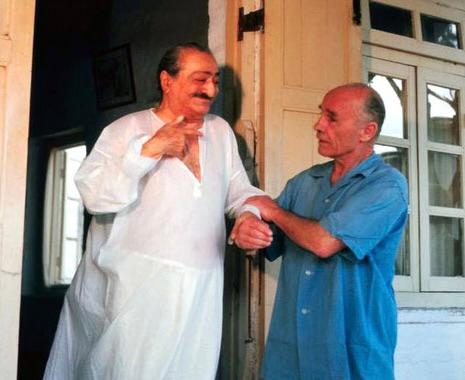
On May 7, a small party of Sufis including Murshida Duce, Francis and Sparkie drove down from NYC to the Myrtle Beach Center to meet Baba. Early in the morning after their arrival Francis entered the Lagoon Cabin to meet Baba. Murshida Duce, who was present recorded this meeting: “When He called in Francis, Baba said via the board, ‘I’ve seen you before, but you don’t remember it do you?’ Francis admitted he did not remember. He perched on the edge of his chair until Baba put him at ease by saying, ‘Sit back, be comfortable, you must know that I am within you, so if you feel like coughing, cough, for it means that I want to cough’.”3 These are the first words that Baba directly “spoke” to Francis. They appear casual, but they contain a deeply comforting message: I know you Francis, I am within you, be totally natural with Me.
Later, Francis wrote: “Baba looked as I had imagined a Sadguru would look – a man who is nothing and everything, a man who is dead and alive, a man who has gone through everything. He is quite small, short, and slight. His eyes are the most remarkable thing about Him; very large eyes, and they are constantly moving. In an ordinary person we would call it restless, but not Him. He did not convey that at all, but conveyed activity. He was kind enough to sign to His three disciples around Him (Eruch, Adi K., and Meherjee) His pleasure in me and that I had come.”4 What is interesting about Francis’s comments of this highly-charged moment is that they are purely descriptive, nearly impersonal. There’s nothing about what moved him deeply in Sparkie’s presence.
Then the “real moment” came, as Francis put it, when Baba asked, “will you do anything I ask you?” and Francis replied, “yes.”5 This indeed was a real moment for in this short exchange Baba, as the Master, offered Francis the gift of obedience, and Francis in return, as the disciple, gave Baba his gift of surrenderance. For as Baba has said: “Love is a gift from God to man. / Obedience is a gift from Master to Man. / Surrender is a gift from man to Master.” And if we stay with this quote, Sparkie’s “gift of love” to Francis could be seen as a “gift from God” (or from Baba as the God-Man), confirming what Francis had thought “that love is not of oneself but is by the grace of the Master.”
At some point, Francis “discussed the whole thing [his relationship with Sparkie] with Baba. And Baba said, rather cryptically, ‘we will see later’.”6 Baba could have directly told Francis to discontinue his relationship, but He left it unresolved. But then without any warning, Baba told Francis to immediately return to Australia for He wanted him to be in Australia when His “Full Free Life” began on July 10. Although he had just made a commitment to Baba to do whatever He said, this directive came as a shock. For how could he now, having found the love of his life and met the spiritual Master of his life, simply leave them both? But true to his word he obeyed and left.
On May 13 he took the bus from Myrtle Beach to New York and began writing. It is interesting that he didn’t choose to make some notes of his meeting with Baba while it was still fresh in his mind. Instead, he began to try and shape into some kind of poetic form the meaning of what had just occurred in his life – meeting Sparkie and Baba.
Before he reached New York he had written a single couplet of 17 syllables (the length of a haiku). Then on the train to New Orleans, where he was to catch a boat to Australia, he had expanded his couplet into 400 lines and on May 29 he had finished what was to become, “Dawn through to Sunrise,” the first poem he wrote after meeting Baba. The writing of this poem marked the beginning of what Francis later called his “true creativity,” which continued for the rest of his life.
The poem begins with Sparkie as the dawn, as the “gift of love”: “When the dawn occurred, it was a certain young woman with blonde hair / Which hung down in curls upon her courageous shoulder.” Then moves to Baba as the sun, the Master who offers him the “gift of obedience”: “When the sun rose, it was a certain Man / by whom the earth was formed, from which / The moon eventually came in lustre.”
Then Francis elaborates further upon these images: “Since the arrow of Fortune’s wheel turned my way, / and dawn entered my heart / making an accommodation for the sun, / I have become a gambler in the markets of this world; / Reckless in the festivals of music, / And shameless in regards affairs of love.” Then comes some lines of warning: “Do not open your eyes to the dawn, / And take no heed of the sun, / Unless you are prepared for ruin, / For dawn is an accommodation, and sky is emptiness, / And the sun is nothing but destruction.”
What jumps out in all of this is the way in which Baba has brought Francis closer to Him through his love for Sparkie. This may be similar to the experience of other Baba lovers, or it may not. Certainly, there are many who came close to Baba who have entirely different stories to tell of how Baba drew them near to Him.
Towards the end of the poem Francis attempts to find some logic behind his experience: “God is to be made a relationship. If you abstract Him / You deny the fact of creation / Fine, if you can do it – / But you still have a mind and a body, / So start where you are / And do not deny His messages, / (In the form of a curl blown by a breeze in the night /From the regions of the moon) …”
At the end of the poem, Francis presents his final thinking: “One must make a relationship of God, / And Sadguru is the best relationship. / One’s father, mother, sweetheart, wife or friend / Is nothing but Sadguru. / Just as the Dawn is nothing but the Sun.” Then Francis adds: “If the sun had not kissed me, / The dawn would have become my pilgrimage. / But since that morning and the bestowal of blessing, / She has become my companion and accommodation. / Therefore is her activity with mine: we walk hand in hand. / And the sun and the rain make our path green, / And our bed is fresh with sea breezes.”
Sparkie and Francis continued correspondence when he arrived back in Australia. As far as I know they never met again. In actual fact, Sparkie later married and for a time was on the committee for Muslim Christian Cooperation in Washington D.C. In 1956 “Dawn through to Sunrise” was published in Francis’s collection of poems, 7 Stars to Morning. The book finishes with the mysterious line, all in caps, “SENDING PARTICULARLY ALL RELEVANT KISSES IN ETERNITY,” which spells SPARKIE when the first letter of each word are joined together.
1. Avatar’s Abode Archives, Francis letter to Ivy Duce, 19 April 1953.
2. Francis Brabazon Poet of the Silent Word, Ross Keating, p. 82-83.
3. Ibid, p. 85-86
4. Ibid, p. 86
5. Ibid.
6. Ibid, p. 88
