September 26, 2025
Kitty Davy’s Unflagging Enthusiasm, Part Two
One day, Wendy Connor was sitting with Kitty Davy in her office in Dilruba, which she affectionately called the “book room.” Wendy was reading aloud a letter that had just come from Professor William (Billy) Baum. He and Kitty had a long correspondence and they both enjoyed discussing words and their etymology. This letter was about the word “enthusiasm.”
“It said that the root of enthusiasm came from the Greek: en Theo” meaning “in God.” And that the entire definition is to be alive with God or to be infused with the divine spirit. Kitty was so delighted by this. She kept asking me, ‘Oh! Isn’t that wonderful?!’” Wendy recounts. “As I’m sitting there, I suddenly realized I was sitting in front of the very essence of enthusiasm. And what was especially touching is that she herself was absolutely unconscious of that.”
Kitty was one of Meher Baba’s earliest Western mandali, having met Him in 1931, and one of the oldest, when she passed away at 100 in December of 1991. She lovingly, selflessly, and wholeheartedly served Him for sixty years, forty of them at the Meher Spiritual Center, where she inspired countless Baba lovers. Her unflagging enthusiasm was contagious and it imbued all she did, from welcoming new and old guests, to counseling people, to listening to classical music to planning a great holiday party. She was irrepressibly cheerful and helpful.
“She was unique. She gave us a sense of what it was like to be with Baba from her training with Baba, and we felt so fortunate,” says Lois Breger, who worked with Kitty in the 1970s and 1980s. “She just did what she felt would be most pleasing to Baba. If she could, she always put someone else’s needs ahead of her own. She was just amazing and it was genuine, and it was all the time. That was her pleasure.”
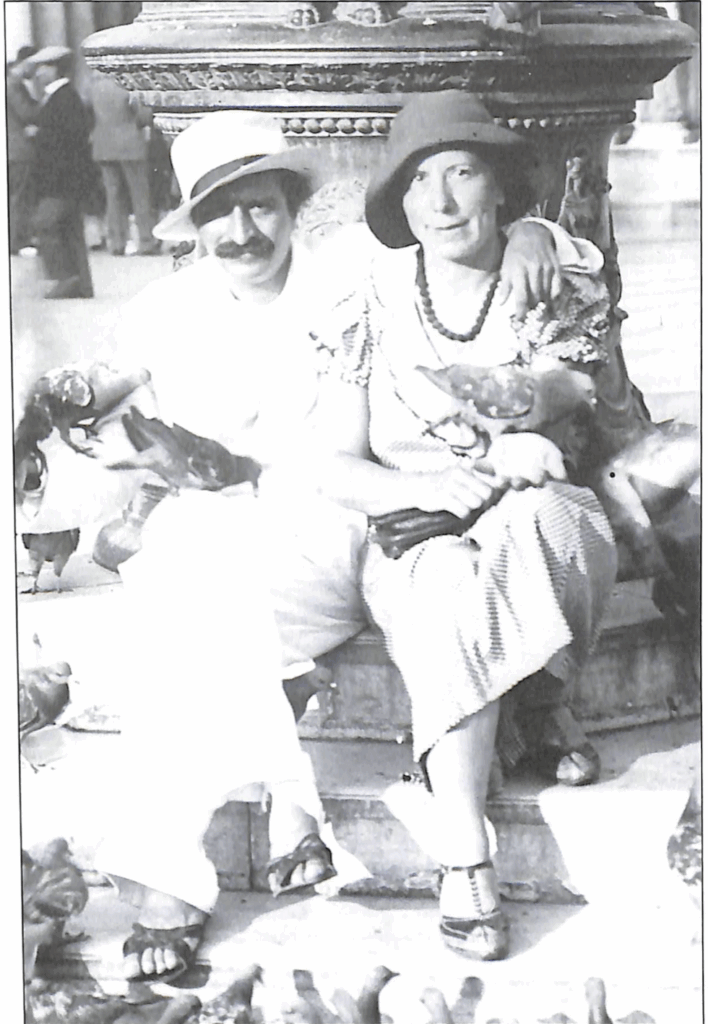
Indeed, in the last year of Kitty’s life, Mani sent her a letter along with a picture of Kitty in Venice with Baba. Mani wrote that looking at the picture of the two made her heart say “…this is a picture of God’s perfect love for a perfect disciple.”1
While Kitty was characteristically unaware of her extraordinary nature, she was quite clear that she was a product of many years spent in Baba’s presence. In her autobiography, Love Alone Prevails, she writes quite frankly about having to learn to cope with her own moods and jealousies as well as learning what it means to obey. In a talk given in Washington, DC in 1980, Kitty said that she gleaned four important things from those years with Baba and watching Him work, the fourth being the most difficult:
• There must be no worry attached to our work. This, Baba says, is one of the greatest obstacles to spiritual progress.
• There must be joy and enthusiasm.
• There must be endless patience.
• To be and to look cheerful and happy, is a spiritual duty! Baba says, a divine art.
For many of the Baba lovers who gravitated to the Center when Kitty was there, she was a living example of that divine art which she shared with everyone who came into contact with her.
She particularly loved planning surprises for Christmas and enlisted the nearby community to help. In 1985, she got two of the Files children (Will and Mikey) to dress up, Will as Santa Claus and Mikey his top-hatted helper. They rode around Dilruba in a tiny toy car delivering gifts to the various guests.
In 1986, Kitty’s co-conspirators were Bob and Jane Brown, and they again enlisted the Files family.
“Kitty’s surprise was wonderful again this year,” writes Buz Connor in an unpublished diary from that time. “The File’s children came as UPS deliverymen flying in jets. We all first were given wonderful clues written by Bob Brown. When we found the hidden piece of paper, we received a gift.”
Janet Files says that the whole idea of making holidays extra special just “tickled” Kitty.
“She was like a little girl with a secret she delighted in. It reminds me of how they would get skits together to entertain Baba in the early ashram days,” says Janet. “Baba had such a delightful sense of humor and loved light-hearted entertainment. Kitty said about herself that she was much too serious at first. It seems like Baba helped bring out her playful side… It was like Kitty aged backward!”
She was just as enthusiastic about pulling down Spanish moss to make the Center look “tidy,” as she was about going out to dinner and having great conversations. She had a formidable intellect and could chat about almost anything from theology to etymology to music, and she especially loved music.
“She loved the Boston Pops and other concerts, oh, she was in heaven,” says Carrie Bills, who lived at Dilruba in the late 1970s. “She would just be tapping her toes and her hands and be in total bliss. Her eyes would close, oh, just to see her be that happy!”
But Kitty was also very grounded and helped others with that as well. Once when Hettie Johnson was helping Kitty in the book room in Dilruba, Hettie confided to her that for the last few months she hadn’t been feeling Baba’s presence as much as usual.
“And Kitty said to me, ‘Oh, I just call those my dry periods,’” Hettie recalls. “And then she went right back to working on the books. It made me feel like, ‘Okay, I’m not losing Baba’s daaman here.’”
When Cathy Riley arrived for the first time at the Center in January of 1972, she was alive with fire for Baba. She and her friend Annie Weld [later Bell] were in the Original Kitchen working on some art. Cathy started feeling like messages were coming through to her, like automatic writing, like she was “very high on the planes.” The phone rang and it was Kitty looking for someone, who wasn’t around. And then Kitty asked Cathy what she was doing.
“So I decided I’d tell her that I was ascending to higher planes,” Cathy says. “Right away, she hooted, and said, ‘No, no, no, no. That’s, that’s not Baba’s way, that’s lower animal magnetism. No, no, no. Take a walk on the beach. Take a cold shower. No, no, that’s not Baba’s way.”
Cathy was later lucky enough to work with Kitty at Dilruba for twelve years and recounts those experiences in her book Dilruba Days. In addition to Kitty’s extraordinary energy, enthusiasm, and discipline, Cathy was also able to glimpse some of her quiet sacrifices and suffering, including dealing with terrible arthritis.
“Sometimes she would just wince with pain, but she’d always make light of it,” Cathy says.
Others who worked with Kitty say the same, that she never wanted to draw attention to herself or disappoint another person, no matter how she herself felt.
“Kitty didn’t run out of steam very often, and when she did it was hard to see, because she was so powerful, for being so tiny, she was so strong but also was very frail,” says Carrie Bills. “Kitty taught me a lot about stamina, devotion, and willingness to serve, always. She never hesitated.”
And in that unflagging enthusiasm, Kitty was for many people like Janet Files, the first real example of how to love God in the most practical way, despite the obstacles. Janet remembers once asking Kitty about her arthritis and whether it hurt all of the time.
“‘Oh yes,’ Kitty said,‘but if I thought about it, I wouldn’t get anything done, would I?’” Janet recalls. “That was her attitude. It was a great example to us of letting her enthusiasm lead her, rather than being bogged down by things. She was the thread that knitted this community together with love.”
1. Saroja, Buz and Wendy Connor, and Sheila Krynski, p. 8.
2. One Fine Thread, by Kitty Davy, p. 158
3. Unpublished manuscript, Buz and Wendy Connor, p. 87-88