October 31, 2025
Alphabet Board Stories
In January 1927, two significant forms of communication occurred: the first transatlantic telephone call between New York and London and the first BBC news bulletin. Another exciting breakthrough in communication took place that January, but of a different kind.
Meher Baba, who had been silently communicating since July 10, 1925, by writing on paper or slate, stopped writing except for His signature. At first, Baba tried pointing at letters in a newspaper, but the print proved too small and the method awkward. Recognizing the need for a better solution, His ever-resourceful mandali began to improvise. Chanji typed the capital letters on a piece of paper, but this too turned out to be too small. Pendu and Vishnu made a chart with larger letters. The chart evolved, and what appeared first on paper transitioned to cardboard, and finally, the alphabet and the numbers zero to nine were painted onto a wooden board.
Bal Natu noted, “Sometimes He used the board as a toss to decide an issue; sometimes He twirled it lightly between His fingers. During musical programs he would tap on it rhythmically. In the early days if Baba noticed that one of the mandali was inattentive or dozing in His presence, a hit with the board would do the needful!”[1]
During the Blue Bus Tours, Baba’s sister Mani had the amazing ability to read the board and take notes at the same time. “‘Reading the board was very natural for me, even upside down,’ she said. ‘I did my own shorthand. Nadine was also taking notes. I helped fill them in.’ “Many times, however, Baba became irritated and told them to stop and listen to Him, or to sit quietly. ‘Why do you need words?’ He asked. ‘Just be with me. Sit before me. Absorb. You’re with me. Make the most of my companionship’.” [2]
After His 1952 car accident in Prague, Oklahoma, Baba wanted to reassure His devotees out west who were anxious to hear from Him. Charmian Knowles shared how challenging reading the alphabet board could be: “By then I’d had some experience interpreting the board, and I was fairly skilled at following His lightning-speed fingers. But this time I kept reading a sentence that just didn’t make sense to me: ‘You tell my West Coast lovers that their patient waiting will bear bitter fruit.’”
I asked, “Bitter fruit, Baba?”
He spelled it again. And again I asked, “Bitter fruit?”
We tried several more times, and then He slowed down considerably. Finally, I exclaimed, “Better fruit! Their patient waiting will bear better fruit!” I couldn’t believe I couldn’t get that word until the end.” [3]
The story of Meher Baba’s alphabet board is also, in part, the story of Eruch Jessawala, who was a master of reading it and would become His main interpreter. Eruch began reading the board as a boy, after coming home from a sports match. Baba would be waiting for him with a different kind of game.
Eruch recalled, “Now this was a game I could enjoy. It was not a baby game like the others, it gave me an opportunity to utilize my intelligence. For it was a challenge, a puzzle to learn how to read Baba’s board. It intrigued me and I used to enjoy trying to read it. For as soon as I learned how to read the board, Baba would speed up. In addition to hearing the stories which were interesting, there was the added factor of competition, for I would always try to keep up with Baba as He went faster and faster, trying to outdo Him as it were in this game. This was more like it, this was an indoor game which I felt was more suited to my age.” [4]
In 1938, when he was twenty-one, Eruch joined Meher Baba’s mandali. By this time, he was skillful at reading the board and able to follow Baba’s nimble flying fingers. Over the years, in conjunction with the alphabet board Baba used a myriad of facial expressions and eloquent gestures to convey His thoughts, often leaving the recipient of His words feeling that Baba was not silent at all.
Fifteen years later, in 1953, while in Dehradun, Baba began dictating to Eruch what was to become His book, God Speaks: The Theme of Creation and Its Purpose. During the day, Eruch would record what Baba communicated on the board, and at night, he would transcribe his notes. Once approved by Baba, Feram Workingboxwala and Bhau Kalchuri coordinated the typing of Eruch’s handwritten pages. Under Baba’s guidance, Eruch contributed to other sections of the book: the writing of Part 9 -“The Ten States of God”, and Part 10 -“Conclusion”.
From September 11-30, 1954. Meher Baba invited twenty of His Western male followers at Meherabad for “Three Incredible Weeks”, which closed with a large gathering including devotees from all over India. It was during this time of fellowship that Baba told His lovers He would no longer use the alphabet board, and Baba issued the “Final Declaration,” which was read out in four languages: English, Hindi, Telugu, and Marathi.
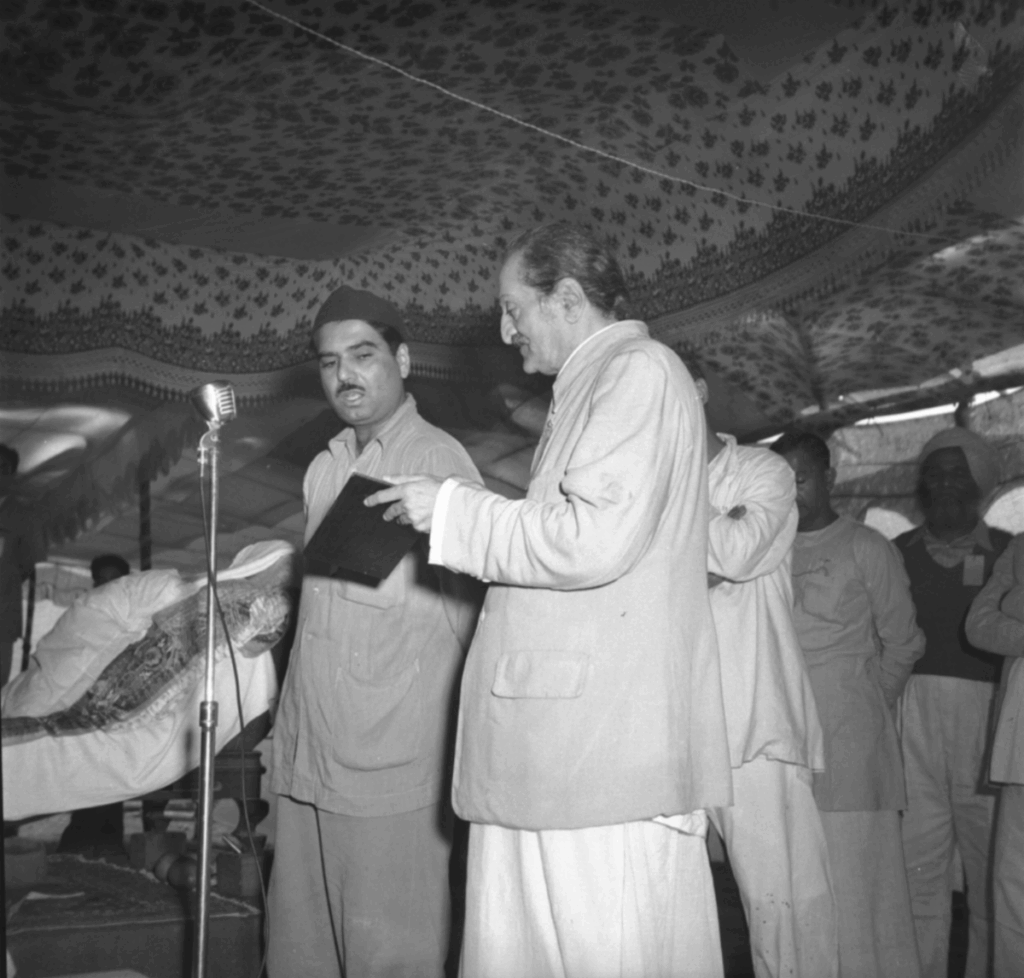
On October 7, 1954, in Satara, Baba put down the board. He did not pick it up again, except for a brief moment. In 1955, Don Stevens, who was filming Baba, asked Him to show how He used to write on the board to dictate God Speaks: The Theme of Creation and Its Purpose to Eruch. Baba said, “I will spell out only this sentence: ‘I have given up the use of the alphabet board for the past twelve months, and I will not use it again.'” [5]
On October 8, 1954, Meher Baba entered the mandali’s bungalow with His hands wrapped in handkerchiefs to deter Him from making any signal with His hands. Previously, Baba mentioned that He would not communicate through hand gestures, as did His disciple Gustadji, who had been silent since May 1,1927. So now, the mandali sat with Baba in silence.
In 1972, Eruch told those gathered in Mandali Hall, “Everything came to a standstill. And we used to sit in the presence of Baba and just gaze at Him and He used to gaze at us, that’s all. Sometimes there would be a smile passing by or something, just gestures of helplessness on the part of the mandali you see.” [6]
While gazing back and forth between the Beloved and His mandali was pleasing, Eruch realized that it was not a long term solution. Gadge Maharaj had asked Baba to come to Pandharpur for a public darshan in November, and people would look to Eruch to receive Baba’s words. What if he misinterpreted Baba’s meaning?
Eruch expressed his feelings to Baba and in time Baba sat down next to Eruch who recalled, “And, then He taught me all in silence about the alphabets that He would use. The signs for each, every alphabet. And then the conversation again started, resumed. And the first time that publicly His gestures were used you see and interpreted was at Pandharpur. In the public.” [7]
On November 9, 1954, Mani wrote to Max and Gisela Haefliger, “Although Baba has stopped using the alphabet board, one does not miss it somehow — just as His free and eloquent gestures and expressions that never needed words. Though often He seems deeply preoccupied and sometimes profoundly sad, His flashes of humour are irrepressible as ever.”[8]
[1] Glimpses of of the God-Man Vol I part 2, by Bal Natu, p. 246
[2] Mehera Meher, A Divine Romance Vol II, by David Fenster, p.19
[3] Spread My Love, by Charmian Knowles, p.53
[4] That’s How It Was: Stories of Life with Meher Baba, by Eruch Jessawala, p.168
[5] Lord Meher: The Biography of the Avatar of the Age Meher Baba, by Bhau Kalchuri, Online Edition, p. 3745
[6] “How Eruch Became Baba’s Interpreter”, Eruch Jessawala, Mandali Hall, Meherazad, India, September 22, 1972 – mandalihall.org
[7] Ibid.
[8] Mehera Meher, A Divine Romance Vol III, by David Fenster, p.133