October 31, 2025
Kitty Davy and the Way of Perfection Part Three
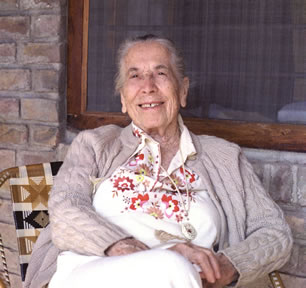
At age 100, Kitty Davy “slipped into her darling Baba’s arms”1 in December of 1991. Several months before, Mani in India noticed a picture of Kitty with Baba in Venice which prompted her to write this to Kitty: “Seeing Baba and you in this picture made my heart say: this is a picture of God’s perfect love for a perfect disciple.”2
Which prompts the question: Just what does it mean to be a “perfect disciple” and what would Kitty have made of Mani’s beautiful description? The reactions of those who loved Kitty and worked with her for many years have a wide range, from delight to dismay. They also illustrate just what made Kitty Davy, already known for her unflagging enthusiasm, extraordinary way with people, and seemingly inexhaustible energy, prompt such praise from Meher Baba’s sister.
“The specialness that was Kitty was born of her surrender to Meher Baba, thus becoming, without even knowing it, a living example of the way of perfection,” said Charles Haynes at Kitty’s memorial service at the Sandy Grove Missionary Baptist Church, which was crowded with more than 500 people. “Through Kitty, Baba made us begin to realize that the death of the false self might not be so painful after all. One could even be cheerful about it!”3
Buz Connor met Kitty in the early 1970s. He and his wife Wendy, Charles’ sister, were lucky enough to have had a long and deep relationship with her. Buz smiled when asked about how Kitty might react to such praise.
“Oh, she’d deny it, but she’d also be tickled by it,” says Buz.
But Roz Taubman, who was close to Kitty and helped edit her autobiography, Love Alone Prevails, has a very different take.
“She’d hate it because she never stopped trying to be better. She never felt like, I got this whole thing of obedience and love. She was always trying harder to the very, very last breath,” says Roz. “There was no separation between her life and work, and her work for Baba was very specific. In Kitty’s mind, it was obedience, it was love.”
Kitty’s life was never easy, nor was it what she expected. And she had plenty of deep disappointments, although one would never know it.
She was forty years old when she met Baba after her brother Herbert first told her about Him. She quickly became one of Baba’s close Western disciples, traveling throughout Europe and India during the early to mid-1930s. Meanwhile, her beloved brother became estranged from Baba.
In 1937, she was one of the few lucky ones who was given the opportunity to “leave everything” to live with Baba in India. She was part of the Nasik Ashram and the Blue Bus tours. But she was also “extremely disappointed”4 when Baba did not choose her for the New Life in October of 1949. Instead, she obeyed Baba’s orders and moved to Bombay and worked, accepting that she might never see Him again.
“The thing about Kitty was that she wanted to do what Baba wanted her to do, unquestionably,” says Janet Files, who met Kitty in the early 1970s and also became close to her. “To me, that’s a perfect disciple. If Baba asked, she obeyed.”
In June of 1951, Kitty was “thrilled”5 to be reunited with Baba, and back to her life in the ashram. But that, too, was to be short-lived.
In June of 1952, after Meher Baba’s accident in Prague, Oklahoma and during his recuperation at Youpon Dunes, He asked Kitty to stay in Myrtle Beach and help Elizabeth Patterson6 and Norina Matchabelli.7 She thought it was temporary. She asked Him “for how long – a month or two? He indicated it would be longer.”8 When He came in ’56, she expected to go back with Him. Her bags were packed. Same in 1958. But each time, He left her at the Center.
“When following the Avatar, be prepared for the unexpected!” she wrote in Love Alone Prevails.9
Initially, her work was to assist Elizabeth and help take care of Norina, which Kitty did with her usual cheerfulness. Then at the 1962 East West Gathering in India, she had again hoped to be asked to stay with Baba. But again, she was disappointed.
“I think I would admit that this was the saddest day of my life; the sadness of realizing that I was definitely to return and whole-heartedly make my home in the West,” she wrote.10
For the rest of her life, Kitty lived and worked in Dilruba with “her incredible cheerfulness, her undauntedness, her kindness, and her energy,” says Roz. “She was on call 24/7, it never stopped.” And it was through her unceasing work that she also inspired an entire generation of young people, becoming a living example of how to serve the Avatar.
Will David met Kitty in the 1970s and worked at the Center. He saw Baba’s perfection in how Kitty treated him. At that time, he had what he considered to be three bosses, Elizabeth, Jane,11 and Kitty. He sometimes got conflicting messages which, over time, started to grate on him. He knew he couldn’t get angry with Elizabeth or Jane, but he was comfortable with Kitty. So one day when Will was in her book room he got really mad at Kitty and let her know it.
“It was just time for me to blow up about having these three women tell me what to do, which in itself, is not always easy for a man,” he says. “Well, how did she greet me the next day? She was open and gentle, just her own loving self. And that’s the power of love.”
Kitty had terrible arthritis and would often be up in the middle of the night, taking laps around the Dilruba living room to ease her pain. (She sometimes even carried her walker, according to Roz, so she could “make better time.”)
As she became more frail, Kitty sometimes needed help even to stand. Bobbi Bernstein was another of Kitty’s close helpers. One night, Kitty took her hand and said, “Let’s stand for God.” And so they did.
“And then it evolved into, ‘Let’s stand in the name of love for God,’ and then ‘Let’s march for God,’ And so she held my hand and we walked across the living room saying: ‘Let’s march in the name of love for God,’” Bobbi recalls. “In the middle of all this, she turned to me and said, ‘Don’t leave Baba.’ And I thought to myself later, why would she say that to me? I was puzzled by those words.”
Bobbi, a musician and prolific songwriter, was inspired to write a song based on that experience. Called “Kitty’s Stand for God,” Bobbi started it then but left it for years and only finished it a year ago. And now she says, with all of the chaos in the world, it all makes sense to her.
“I think Baba wants this message out, ‘Let’s stand in the name of love for God.’ ‘Let’s hold tight to His daaman,” says Bobbi. “In this crazy time, crazy time, hold tight and march forward.”
Cathy Riley, who also helped take care of Kitty in her later years, once “stalked” Kitty for a whole day, trying to catch her in a single selfish moment. She failed.
“I watched her in everything she did, and there was no selfishness, none” says Cathy, who writes about it in her book Dilruba Days. “Kitty was the perfect servant, because she wasn’t there, I mean, her ego was not in place.”
Kitty also never let go of her desire to serve Baba and became increasingly frustrated that her frailty impeded her ability to work as she aged. She loved Milton’s poem, “On His Blindness,” which is about Milton’s perception that his blindness impeded his ability to serve God. Kitty would often ask Lois Breger, who also helped edit Love Alone Prevails, to recite the poem with her. It ends with the line: “They also serve who only stand and wait.”12
“She got great succor from that,” says Cathy. “She got hope that although she could only sit and wait, she was still serving Baba. Yes, she also serves who only sits and waits.”
1. Saroja, Buz and Wendy Connor, and Sheila Krynski, p. 8.
2. Ibid, p. 14.
3. Ibid
4. Love Alone Prevails, Kitty Davy, p. 336
5.Ibid, p. 351
6.Elizabeth Chapin Patterson, cofounder of the Meher Spiritual Center
7. Norina Matchabelli, cofounder of the Meher Spiritual Center
8.Ibid, p. 403
9.Ibid
10.Ibid, p.595-596
11.The Poetry Foundation, https://www.poetryfoundation.org/poems/44750/sonnet-19-when-i-consider-how-my-light-is-spent