January 30, 2026
The First Amartithi on the Sacred Hill
When I think of Amartithi, the Eternal date, images of huge, flowy pandals come to mind. Thousands of people under them in a united mass – the elderly, the very young, rich, poor, eastern, western, new and old, merging together in a rushing stream into the ocean – His Tomb shrine.
As we approach the fifty-seventh Amartithi, my mind slips back in time wondering what the first Amartithi might have been like. How did the mandali, still absorbing the colossal shock of the loss of His form, manage to put on this big event? How did the events of the year since Baba’s dropping of the body inform their choices? And how much of Amartithi as we know it today was derived from that very first one?
Elizabeth Patterson and Kitty Davy travelled together from Myrtle Beach, South Carolina to Meherabad, India for the first Amartithi in 1970. In a letter to Charles Haynes dated February 9th, 1970, Elizabeth wrote, “The first Anniversary Commemoration at Meherabad-on-the-Hill in the shade of Baba’s Tomb was a very beautiful occasion; it was not sad, as all felt Baba’s Eternal Presence.”[1]
At an informal talk at the Saroja Library given on February 20th, 1970, freshly back from the trip, Elizabeth and Kitty shared their experiences of the first Amartithi.
Riding up to Meherabad Hill, where Kitty and Elizabeth had stayed years ago with Baba, they remembered so many wonderful times with Baba. Elizabeth says, “I like to call this part of the story ‘paradise relived’ or ‘regained’…there is a great importance to where the Master is buried.” [2]She goes on to explain that it’s never just the place that He is buried in. It is the “Master’s seat,” where He has done His work and made the place holy. During their time there with Baba in the 1930s, although Meherabad Hill was a retreat, Baba said that it would become a place of great pilgrimage.
No better time than the first Amartithi for Elizabeth and Kitty to experience first-hand what Baba meant. Eighteen hundred pilgrims stayed at Meherabad for the first Amartithi. But many more came who did not spend the night. “And they had these great tents, they’re not like the circus tents, or anything of that kind, they have white sides, and then there is beautiful coloring on the top. All the women are in one and the men are in the other,” said Elizabeth. “And they were divided by [Indian] States,” [3]Kitty adds. This practice continues on even now.
Today, Lower and Upper Meherabad are covered in tents that are allotted by states where mattresses are laid on cold floors and bucket baths are taken with cold water but hearts are kept warm with His presence.
For that first Amartithi, food was cooked in great cauldrons and served to all – a great miracle in itself. Today, similar food practices are supplemented with food tents where food is sold from all the different states. Some communities will bring their own food to cook to accommodate their dietary and economic needs.
In 1970, all the eighteen hundred had arrived by car, busses and trains on the evening of January 30th. Trains made a special stop at Meherabad for the pilgrims to alight just as they still do. The biggest crowd was from Andhra!
On January 31st, the program began at 10 o’clock in the morning and bhajans were sung from all the different states. At noon, silence was observed for fifteen minutes to be broken with a fervent “Avatar Meher Baba ki Jai.” After the silence, Baba’s prayers were read out in six different languages: English, Hindi, Marathi, Telugu, Tamil and Bengali. “Just like Jesus left us the Lord’s Prayer, I imagine that the Parvardigar [The Master’s Prayer] will be a prayer for all time. And people will always remember that Baba Himself, however ill He was up to the last day, when that prayer was said, He always stood for it,” [4]Elizabeth reflects.
Amidst all this hullabaloo of love, the women mandali cloistered around Mehera holding her pain tenderly as she had to take centerstage while still grieving. Words cannot and should not be subjected to describe what Mehera went through the year before. Many had thought that she would never recover. But Baba watched over His Mehera. How could He not? The year brought so many of His lovers from all over the world, who sought Him in her. “As Mani recalled, the mandali had to do just the opposite of what they planned in Poona – they had to expand, not cut back!”[5] Mehera started to tell her stories, tears in her eyes, slowly building courage toward a life that He willed for her to live after Him. That year also brought the appearance of His image in the umar tree right outside her window, giving her great solace in His eternal presence and nazar.
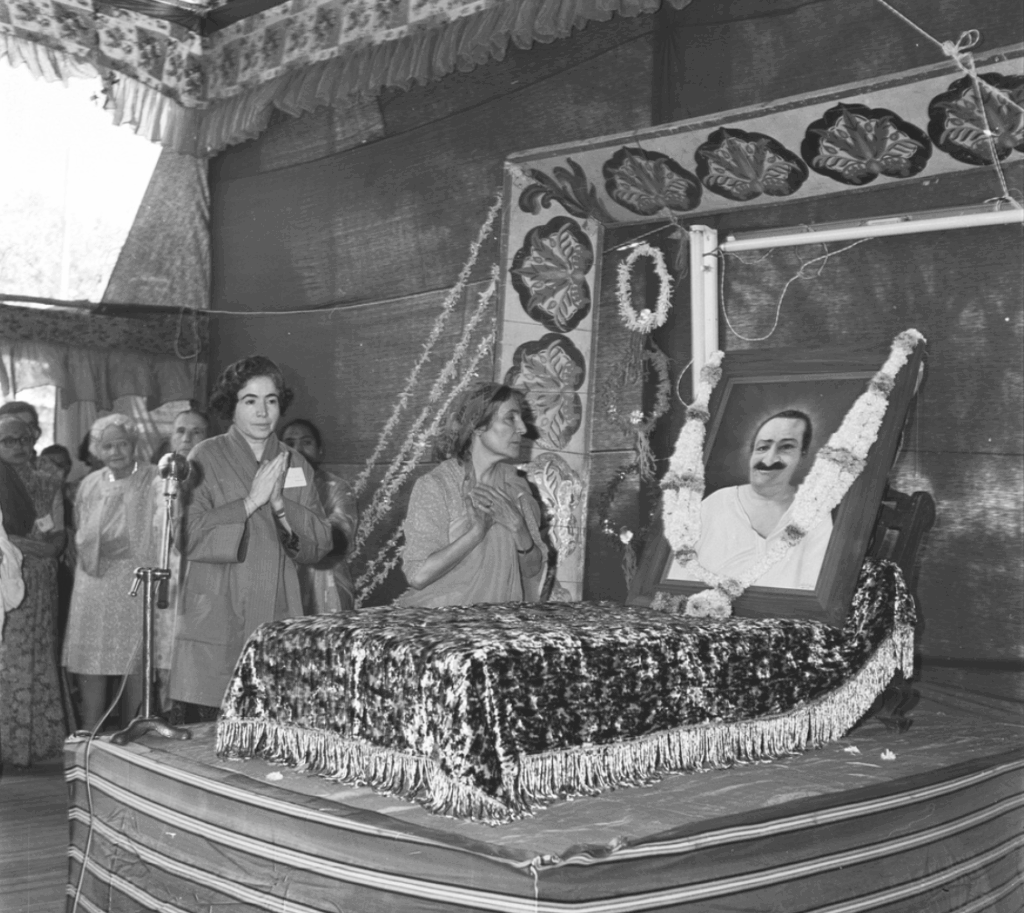
On January 31st, Mehera stepped up to the mandap to unveil a painted portrait of Baba placed on His gadi. After this, the tomb area reverberated with the singing of Baba’s Artis.
One of the most touching events from the first Amartithi was when Mehera spoke to the crowd. “Mehera was on…she faced everyone, was facing…well, whether you call it the ‘stage,’ or whatever it was, the dais, and Mehera stood facing the Tomb. And she addressed this to Baba. And that was very touching,” [6]says Elizabeth.
Heather Nadel writes, “On the first anniversary of Baba’s dropping His body, January 31, 1970, someone made a film of the gathering in Meherabad. There you see Mehera giving a message on the stage over the microphone. Her fragile vulnerability and the poignancy of her grief are startling. Mani is standing by her side, holding her arm and directing her steps. It is an apt illustration of the support Mani and all the close women gave to Mehera in those first years.”[7]
As the Tomb remained open all night for pilgrims to take darshan and the festivities continued until noon of February 1st, I am sure the purity of love in Mehera’s words lingered in the air in utter reverence. Perhaps, the words linger still on that sacred hill between crevices and white painted rocks, on cold stone and in the rustle of the neem trees to be felt by lovers who approach the hill from all directions. Still fragrant and alive with His presence continuing to provide sacred solace and matchless sustenance.
Mehera’s speech:
O Beloved One, our Beloved Avatar Meher Baba! We, your loving children, have gathered today at Meherabad to fill our hearts with your love on this most sacred hill on earth where your Man-Form rests. We have also come to pay our homage to you and to greet you in the hearts of your lovers. May we be worthy of your very dear love for us. Your compassion is our strength, which sustains us. Your love is our life – it is yours. May we hold on to your daaman in complete surrender to your will.
Dear Meher pilgrims! We are all gathered here in love to pay homage to Avatar Meher Baba, our Divine Beloved who loves us more than we can ever love ourselves. Let us forever say his Jai – not only say it with our lips but live it in our hearts, so that our lives become a living testimony to his Victory. Avatar Meher Baba Ki Jai![8]
[1] Letters of Love, By Jane Barry Haynes, p.463
[2] One Fine Thread, by Kitty Davy, p.30
[3] Ibid, p. 31
[4] Ibid, p.34
[5] The Joyous Path, by Heather Nadel, p.880
[6] One Fine Thread, by Kitty Davy, p.36
[7] The Joyous Path, by Heather Nadel, p.881
[8] Mehera Meher, Vol. 3, by David Fenster, p.528