May 29, 2026
Gulmai: Meher Baba’s Spiritual Mother
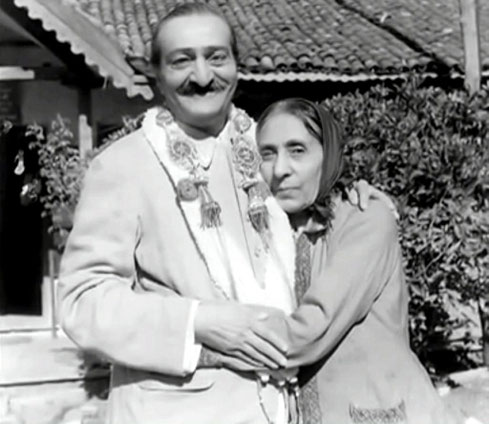
This Mother’s Day, I thought of Gulmai. The humble, steadfast and silently suffering woman who Meher Baba called His spiritual mother.
Gulmai was the wife of Kaikhushru Sarosh Irani, a prominent businessman and civic leader in Ahmednagar. She was also one of Upasni Maharaj’s disciples. She was then 36 and the mother of four children. Married at an early age, she had encountered many problems in her life and, prior to meeting Maharaj, had been depressed and unhappy at her joint-family home.
Adi Sr., who later became Meher Baba’s secretary, was one of her sons whom Baba had asked her to “give to Him.” About his mother, Adi said, “Gulmai was an emblem of silent suffering. She was of a very quiet temperament. She had a delicate fair body but a stout heart. She was born in Bombay and her father was a carpenter. She had one sister and one brother. She could not easily mix with people, having led the best part of her married life almost by herself and her children, to whom she could not give what she wanted. She had to depend on other members of the joint family for food, clothes and all other necessities of life for a number of years. This, coupled with her nature of not depending upon others and her deep affection for her husband and children, could not let her live happily. Deep inroads of suffering were created in her finer mettle and thus there was a growing dissatisfaction with life and surroundings.”1
Initially, Gulmai had no interest in meeting Upasni Maharaj. After some resistance, she agreed to accompany her sister Soonamasi and brother-in-law Kaikhushru Beheram Irani to Sakori to see him. On meeting Upasani, she realized that the unconventional and near naked Master was the very one that had appeared to her in a dream. She fell at his feet and although she felt mixed emotions, Upasani assured her that he knew everything and that she need not tell him anything. She then begged him to accept her surrender of mind, body, progeny and possessions. Upasani said, “Your Zoroaster is here. I am closely linked with Zoroastrians and, in the future, they will flock to me in large numbers.”2
Upsani was correct. Zoroaster in the latest advent was present, right there at Sakori in the form of Merwan Seth. Gulmai had heard of Sheriar Moondegar’s son, the one who sang beautifully. She enjoyed Merwan’s soulful and comforting singing on many occasions. Over the years, while in Sakori, she and Merwan Seth (Meher Baba) often met. He revealed to her His spiritual experiences, which convinced her beyond doubt that He was, in fact, the chargeman (spiritual heir) of Sadguru Upasni Maharaj.
In 1919, Maharaj told Gulmai’s family, “I have poured my entire spirituality into Merwan. You must stick with Him through thick and thin. I am now an empty vessel.”3 From then, Maharaj would drop many hints about Merwan’s status and Gulmai’s connection with Him. And Merwan would begin to make her aware of her role as his spiritual mother.
Gulmai’s contact with Meher Baba increased during 1920, as she came to Sakori more frequently. In her memoirs, Gulmai notes Baba’s revelation to her in 1921, “Pila[mai] from Karachi [the paternal aunt of Goher and Katie Irani] had come to Sakori for the first time, and stayed for a month with her children. She, Yeshwantrao and I were sitting around Merwanji one day. Calling me near, Merwanji said, ‘Sit here, Mother. I have something to tell you. Every Sadguru has a spiritual mother. Durgabai is Maharaj’s spiritual mother; Narayan Maharaj and Tajuddin Baba have one also. Similarly, all have spiritual sisters too. You are my spiritual mother. I have past connections with you since many lives. I am telling you the fact that I am your son. You are the most fortunate woman in the whole world.’ I did not understand what he was saying and told him, ‘I know nothing about these so-called facts. I am not worthy of all this. I am not even equal to the dust under your feet. I am a simple woman, tired of life, and with a desire to stay with Maharaj, serve him and die at his feet.’”4 Later Baba said, “you will be like Babajan.”
On another occasion while travelling with Maharaj, he said, “The Sadguru is like the engine,” he remarked. “If the compartments are joined to him, he takes them to the destination desired. Similarly, join your compartments to Merwan (Meher Baba) and He will carry them to their respective (spiritual) stations.” He added, “When I provide Merwan with the engine, your prophet Zoroaster will manifest!” To Durgabai (his own spiritual mother and close companion to Gulmai during her visits to Sakori) Maharaj had already revealed Merwan to be the Avatar.5
Another time, after bhajans at Sakori, Merwan took Gulmai inside His hut and had her sit on a wooden crate, while He sat on the floor near her. She felt awkward sitting like this and started to join Him on the floor. He stopped her and, holding her hand, said, “I want you to know that you are My mother; I am your son. We are connected from the very beginning; I have taken birth through you in past lives. I have much work to exact from you in the future. A day will come when I shall elevate you.”6 He then placed His head on her shoulder, and they sat quietly together for a while.
In Manzil-e-meem, placing his hand on the switch of a light at the Manzil, Baba once said, “Look, here is the bulb connected by a wire to the switch. I just press the button and there is light. Similarly, when the Sadguru will press the button, the spiritual mother will have illumination. Until then, patience is required.” He would give the example of a fetus, which has to live in captivity in the mother’s womb for nine months. If it is not given the full time, it becomes useless. “I am also bound,” he explained. “I want to be free, and I also want to make you free.”7
Gulmai served Meher Baba with a purity of intent that befits a mother. She cooked and cleaned for him. Much to His liking and request she sang soft songs filled with dard (pain) to Him and never hesitated to follow any order even if it were most seemingly unreasonable. She was also the one to present him with a sadra for the summer heat – a light garment which would become His standard dress from then on. Another interesting detail was that Gulmai was one who combed Meher Baba’s hair as it started to grow longer. In her absence, Gustadji attended to it. Later, Mehera took on the role to perform this duty just as attentively as Gulmai. She performed her spiritual motherly duties to such an extent that it sometimes led to strife between her and Shireenmai, Baba’s material mother. On one occasion (19 October 1938), Adi Sr. noted in his diary: “Shireenmai as usual becomes jealous of Gulmai, and Baba is so much troubled by the situation. He suffers.”
The story of Gulmai is incomplete without the story of Meherabad. An unmissable provision that the spiritual mother provided for Meher Baba was the land near Arangaon which would become the site for His ashram and His tomb shrine. Her husband Kaikhushru had acquired the desolate land that was used in World War 1 as military barracks and had no plans for it. But a hint was provided by a local saint, Hazrat Gilori Shah, who wanted to be buried there because he predicted the arrival of a perfect one in the area. It was upon Gulmai’s persistent insistence that Meher Baba agreed to visit. The rest is history.
Gulmai lived and served Meher Baba until her death in 1962 after being nursed by Baba and His love for her. When she died, her body was taken to Mehererabad for burial. Baba remarked to Adi, “She is very fortunate that I was present at her burial.” Gulmai was, in fact, the first person to be buried on Meherabad Hill. As if in an additional tribute to her greatness, this was the last time Meher Baba ever went to Meherabad.8
Adi said, “Her single-minded devotion to Meher Baba was exemplary. This was in no less measure due to Meher Baba giving her the exuberance of His love and affection as a mother. The name Gulbai was turned into Gulmai by Meher Baba (mai means mother). 9
1.The Awakener Magazine, Vol. 19, No. 1, pp. 4-5, ed Filis Frederick
2.Ibid
3.Ibid
4.Memoirs of Gulmai ed. David Fenster and Keith Gunn, pp. 51-52
5.https://trustmeher.org/meher-baba-close-disciples/women/gulmai-k-irani
6.Ibid
7. Memoirs of Gulmai ed. David Fenster and Keith Gunn, pp. 96-97
8. https://trustmeher.org/meher-baba-close-disciples/women/gulmai-k-irani
9.The Awakener Magazine, Vol. 19, No. 1, pp. 4-5, ed Filis Frederick